ETF Prime Archive

Check out our archive of podcasts

ETFs vs. Mutual Funds: The Age-Old Question

The following was authored by Paige Kyle, Capital Markets Associate at WisdomTree.

One of the most common questions and discussion points we encounter is: “What are the key differences between exchange traded funds (ETFs)  and mutual funds?” Both are investment vehicles designed to give the investor exposure to a basket of securities, but there are important distinctions between the two structures in terms of transparency, trading and tax efficiency. Our CEO, Jonathan Steinberg, likes to use the analogy that mutual funds are like black-and-white TVs and ETFs are like HDTVs in full color.
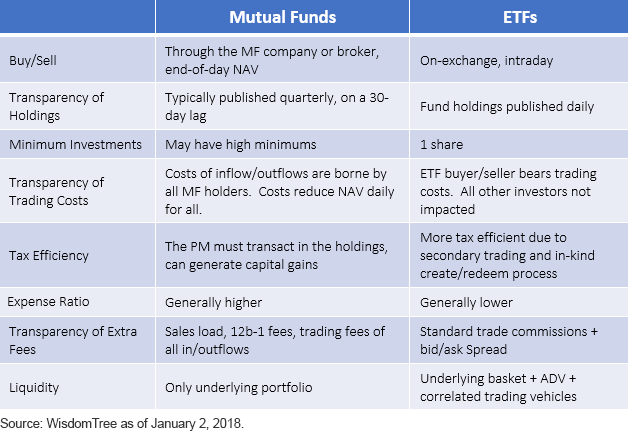
ETFs Vs MFs

The first key difference between ETFs and mutual funds is transparency. The holdings of ETFs are published daily, so as an investor, you know exactly what you are holding. Mutual fund holdings are published quarterly and usually on a lagging basis. By the time the holdings are published, what the mutual fund actually holds could be quite different. Furthermore, ETFs are much more transparent in terms of trading costs. The ETF buyer or seller bears the trading cost without impacting other investors of the fund. Additionally, the trading costs are imbedded in the ETF spread, which the buyer or seller pays, plus commissions. For mutual funds, the costs of inflows and outflows are borne by all holders of the mutual fund. Any trading activity that occurs in the portfolio, such as trading to accommodate daily inflows and outflows, will impact those who hold the mutual fund. In terms of fees, many mutual funds have sales loads, 12b-1 fees and trading costs that are not transparent since they are not exchange traded. Many investors think they are getting net asset value (NAV) but in reality, it is NAV minus the unknown trading costs.

The second key difference between the two products is trading. A mutual fund investor can only receive NAV minus costs of a mutual fund at the end of each day. An ETF can be bought or sold throughout the entire trading day. Additionally, since an ETF is exchange traded, that adds a further layer of liquidity. Shares of an ETF have the potential to be passed back and forth on exchange without a transaction occurring in the underlying securities. This can potentially lead to cheaper costs compared to trading the underlying basket. This does not happen with a mutual fund. The portfolio manager will always have to transact in the underlying securities when buying or selling for an investor, especially in larger size.

The last key difference between mutual funds and ETFs is tax efficiency. While both structures are taxed equally on the individual level, the key difference occurs at the fund-holdings level. At the end of the year, if the fund had netted gains from selling securities, this amount must be distributed to the fund’s shareholders, who are then required to pay taxes on this distribution. ETFs are more tax efficient on the fund-holdings level due to their exchange-traded nature. Shares of the ETF can be passed back and forth on the exchange without creating turnover in the underlying portfolio, thereby reducing the chance for capital gains. The second contributing reason is due to the “in-kind” creation and redemption mechanism. Securities and ETF shares are exchanged between the authorized participant and the ETF issuer during a creation or redemption, free of payment, meaning no transactions occurred within the portfolio. Mutual funds have neither of these benefits, making them more prone to taxable events.

While ETFs and mutual funds are both a wrapper around a basket of securities, there are many key differences. ETFs provide much more transparency, flexibility, tradability and tax efficiency compared to their mutual fund counterparts. The investor knows exactly what he or she holds, and all of the costs and fees are transparent. Furthermore, an ETF investor will not be impacted by the actions of other holders of that ETF, whereas a mutual fund investor is at the mercy of other holders of that fund. So in a world of technology, would you prefer a black-and-white TV or a flat-screen color HDTV?

Important Risks Related to this Article

Neither WisdomTree Investments, Inc., nor its affiliates, nor Foreside Fund Services, LLC, or its affiliates provide tax advice. All references to tax matters or information provided on this site [in this material] are for illustrative purposes only and should not be considered tax advice and cannot be used for the purpose of avoiding tax penalties. Investors seeking tax advice should consult an independent tax advisor.

What Goes Up Doesn’t (Necessarily) Have to Come Down

Nathan Geraci is President of The ETF Store, Inc. and host of the weekly radio show “The ETF Store Show“.

The 2017 stock market might best be characterized as long in frightening headlines, short in volatility, and strong in returns.  The S&P 500 registered its second-best year since 2009, despite a seemingly never-ending flow of negative news.  The Robert Mueller investigation, growing tensions with North Korea, devastating hurricanes, overseas terrorist attacks, horrific domestic shootings, Charlottesville – the headlines were enough to give even hardened investors pause.

Remarkably, despite it all, the S&P 500 closed every single month of 2017 with positive gains – the first time that has ever happened.  That monthly winning streak actually extends back to November 2016 and stocks have now increased in 21 out of the last 22 months!  Volatility has been virtually non-existent.  The S&P 500 went the entire year without an intraday decline of more than 3%.  The largest gain?  1.4%.  Stocks essentially “melted up” in the lowest volatility year on record.  Notably, foreign stocks fared even better in 2017, with developed international stocks gaining nearly 27% and emerging market stocks jumping over 31%.

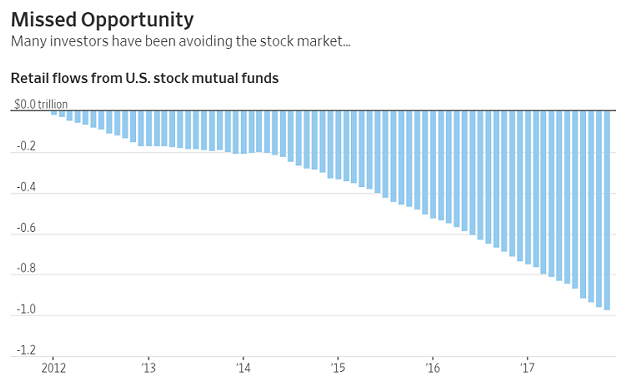
In last quarter’s commentary, we discussed how to survive a bull market.  As stocks continue rising, like the S&P 500 has done every year since 2009, investors have a natural inclination to become more risk averse.  There is a growing urge to take some winnings off the table. The following chart illustrates this, with investors increasingly pulling money out of mutual funds as stocks continue their ascent:


Source:  The Wall Street Journal


Now, it should be noted that an estimated 40% of these outflows consist of money being pulled from expensive, underperforming active mutual funds and being invested into lower cost ETFs.  Also, some investors may simply be rebalancing or repositioning into other areas such as international stocks or fixed income (though that still points to a desire to reduce exposure to U.S. stocks).  Nonetheless, a meaningful portion of outflows can be attributed to some investors growing ever more cautious.  The prevailing narrative among these investors is that stocks cannot continue to post gains year-after-year and valuations are overextended.  However, by taking money off the table, these investors miss out on subsequent returns as the bull market continues charging ahead.  That is why bull markets can be so difficult for investors to “survive”.

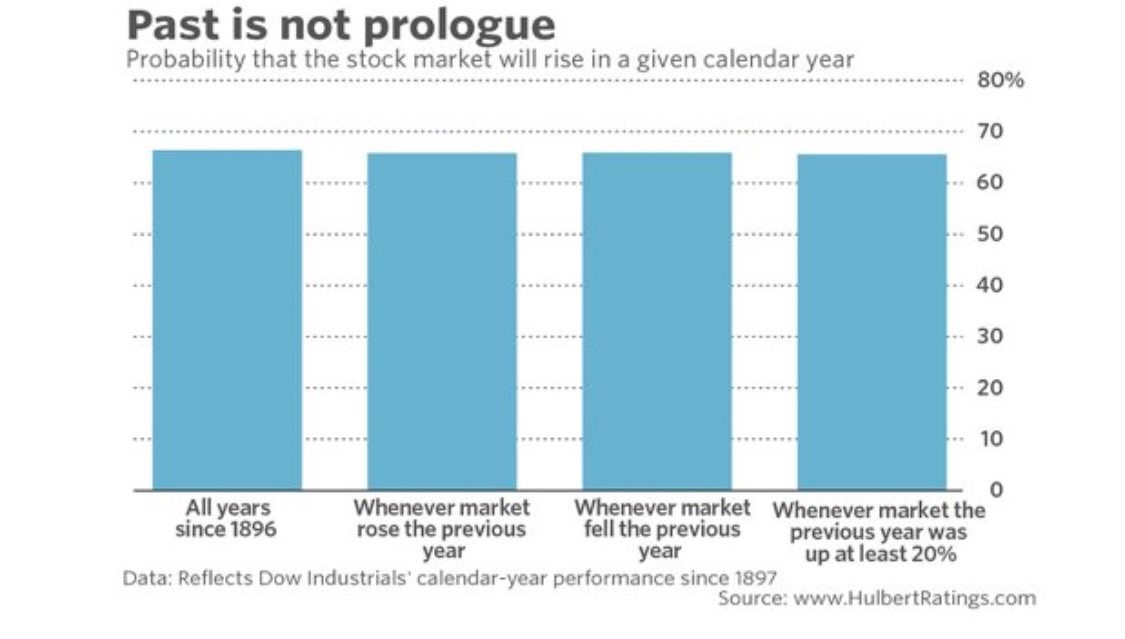
As it relates to stock valuations, it is important to remember they tend to be poor market timing tools.  While stocks are on the pricey side, they can remain so for long periods of time.  Valuations are meaningful indicators of the probability of future returns (i.e. when valuations are high, future returns are likely to be lower – though not necessarily negative), but their ability to predict shorter-term market moves is extremely limited.  In terms of the stock market’s ability to post gains year-after-year, consider that according to The Wall Street Journal’s Market Data Group, when the S&P 500 has gained at least 19% in a particular year as it did in 2017, it has managed to produce a positive return the following year 68% of the time (with an average gain of 8%).  In other words, just because the market has gone up, that does not indicate a higher likelihood of a decline.  The probability that stocks will rise is actually consistent across a variety of scenarios going back to 1897 (using the Dow Industrials):

Source:  The Fat Pitch


That is not to say the market cannot or will not decline in 2018.  The fact that stocks have increased for 14 straight months without an intraday decline of even 3% is highly unusual.  It is not realistic to expect that to continue.  A normal year in the markets typically includes a roughly 10% decline in stocks at some point.  According to JP Morgan, since 1980, the average intra-year drop has been 13.8% (though note that annual returns have been positive in 29 of those 38 years).  Volatility is a normal part of investing in stocks and, as an investor, you should be mentally and financially prepared for it.  The Robert Mueller investigation is still ongoing.  The saber-rattling between the U.S. and North Korea has only intensified.  Mid-term elections are on the horizon, which could shift the balance of power and the political landscape.  There are always “unknown unknowns”.

On the other hand, the U.S. economy and corporate earnings continue to grow.  The U.S. economy is currently experiencing its third-longest expansion in history and may reach its second-longest by midyear.  The new tax bill, along with a possible infrastructure spending bill, offers the potential for additional positive economic impact.  The Federal Reserve, while expected to raise rates three times in 2018, continues to take a cautious, measured approach to monetary policy.  Inflation is in check.  Volatility is still low.  Some would call this a “goldilocks” environment for investors.

2017 was an excellent year for stocks.  2018 has the potential for another strong year.  However, stocks are in a bull market until they are not.  To continue surviving (and thriving) in the current environment, we’ll leave you with two of our favorite investing quotes:

“If you have trouble imagining a 20% loss in the stock market, you shouldn’t be in stocks.” – John Bogle

“There will always be bull markets followed by bear markets followed by bull markets.” – Sir John Templeton

Risk is part of the financial markets, as are longer-term rewards.  The key to surviving a bull or bear market is finding the right balance between risk and reward for your particular situation – our primary goal at The ETF Store.

Lastly, we wanted to share a unique and stunning image recently captured by a long-time, valued client.  The photo depicts an early morning “crescent moon rising” over the Kansas City skyline.  We hope you enjoy it as much as we do (it’s now hanging in our ETF Store offices)!

Courtesy of Craig McCord Photography.  Scenic Impressions and the Pursuit of Light.


Why Are Investors Still Paying High Mutual Fund Fees?

Despite high fees and underperformance, investors still have more than $10 trillion placed in active mutual funds.  Nate & Jason explain the reasons why and highlight an example of why switching to lower cost funds may not be as easy as you think.  Maxwell Gold, Director of Investment Strategy at ETF Securities, discusses the current gold market, a bull and bear case for gold in 2018, and bitcoin.

Skip to content