

RIA vs. Broker – Do You Know the Difference?
Listen to The ETF Store Show every Tuesday at 9am on ESPN 1510 as we cover everything you need to know about Exchange Traded Funds and the world of investing.
Click here to listen to The ETF Store Show now.
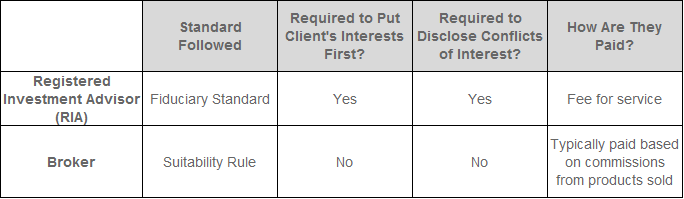
Do you know if your financial advisor is legally required to act in your best interests? Many individual investors think the answer to this question is obvious – “of course they are”. Unfortunately, and surprisingly to many investors, that’s not necessarily the case. In the financial services industry, so-called advisors operate under many different titles – Financial Advisor, Financial Planner, Stockbroker, Registered Investment Advisor. Regardless of the title, many investors make the assumption that their financial professional is always looking out for their best financial interests. What may come as a shock is that only Registered Investment Advisors are legally required to look out for your best financial interests.
On our most recent radio broadcast, attorney Eddie Greim, partner with Kansas City law firm Graves Bartle Marcus & Garrett, joined us to discuss the differences between a Registered Investment Advisor and a Broker (which is what many so-called “advisors” actually are) and the impact these differences can have on the types of investment product recommendations you receive. You might be surprised to learn that it can be perfectly ok for brokers to sell you the highest fee mutual funds and receive a nice fat commission check for doing so. At The ETF Store, as a Registered Investment Advisor, we must put our clients’ interests ahead of our own and we don’t receive commission checks for recommending expensive investment products. We believe that it’s of the utmost importance that you understand whether the financial professional you’re using is a Registered Investment Advisor or a Broker – the potential impact of this distinction can have a profound effect on your long-term investment returns. Below is a quick chart on the key differences between the two:
In our weekly ETF Spotlight segment, we examined one of the least expensive ETFs on the market and one that offers exposure to 750 of the largest U.S. companies (Schwab US Large-Cap ETF – ticker SCHX). For an unbelievable 0.04% annually, you can obtain broad based exposure to the US stock market and own companies like Apple, Exxon, Google, and GE. Compare this ETF to the average actively managed mutual fund which has an expense ratio of around 1.50% and underperforms its benchmark the majority of the time. Learn more about SCHX by visiting www.etfbuzz.com.
Costly Mistakes Can Derail Retirement
Listen to The ETF Store Show every Tuesday at 9am on ESPN 1510 as we cover everything you need to know about Exchange Traded Funds and the world of investing.
Click here to listen to The ETF Store Show now.
On our most recent radio broadcast, we walked through the 8 common mistakes that retirees make as outlined by Paul Merriman on The Wall Street Journal’s Marketwatch. At The ETF Store, we spend a great deal of time focusing on ETFs and ensuring our client portfolios are properly positioned, but we also work with clients to put together comprehensive financial plans to help them reach their financial goals. For retirees, this process includes discussing all of the key factors that go into a financially successful retirement. There are many potential pitfalls that can derail your retirement and any one of these pitfalls can have disastrous results. On our show, we discussed each of the pitfalls listed in Mr. Merriman’s article and explained how you can avoid them:
- Failing to develop a budget.
- Failing to budget predictable expenses such as income taxes or home repairs.
- Basing your standard of living on unrealistically high returns from your investments.
- Withdrawing more money from your retirement portfolio than your portfolio can support over the long-run.
- Overreacting to bear markets.
- Hanging on to risky investments for too long.
- Purchasing illiquid investments.
- Giving away too much money to either charities or children.
In our weekly market update, we delved into gold and Japanese equities, two areas that have garnered a lot of media attention recently and both of which have been significantly impacted by central bank monetary policy. We looked at what’s next for both assets and explained how, as always, proper portfolio diversification can allow you to sleep at night regardless of how these assets perform. Speaking of portfolio diversification, in our weekly ETF Spotlight segment, we examined a broad based, developed international equity ETF (iShares Core MSCI EAFE ETF – ticker symbol IEFA) and explained how international equity exposure can offer diversification benefits to your portfolio. Learn more about IEFA at www.etfbuzz.com.