

Top 5 Reasons to Work with a Financial Advisor
Listen to The ETF Store Show every Tuesday at 9am on ESPN 1510 as we cover everything you need to know about Exchange Traded Funds and the world of investing.
Click here to listen to The ETF Store Show now.
It seems that just about everyone knows a financial advisor, but for a variety of reasons, not everyone chooses to work with a financial advisor. For some do-it-yourself investors, given their particular situation, this makes perfect sense. For many other do-it-yourselfers, however, there are several very compelling reasons why working with a financial advisor can be the best path towards reaching long-term financial goals. A financial advisor can cover a wide range of monetary responsibilities, from expenditure to looking after the accounts. If you’re not entirely sure about working with one, do some research about what makes a good financial advisor. There are qualifications that they can work towards; accountants for example may take the CPA exam to fully qualify (check out the Surgent CPA Review vs Becker to see which CPA course works best) while there are plenty of other exams and qualifications to look out for. At The ETF Store, we’ve pinpointed five key reasons why investors should consider working with a financial advisor and we shared each of those reasons during our most recent radio broadcast. Listen to the full show as we go into detail on the following top five reasons to work with a financial advisor:
- Investing can be hard.
- You’re too busy to properly manage your investments.
- You need an investment plan.
- You don’t know what you’re paying for your investments.
- You simply can’t sleep at night worrying about your investments.
In our usual weekly market update, we took a look back at 1st quarter market performance and explained how some investors failed to participate in the roughly 10% increase in US stocks that seemed to get lost in the blizzard of negative news during the quarter. We also offered some thoughts on what to watch for from the markets during the 2nd quarter. In our ETF Spotlight segment, we highlighted a dividend paying stock ETF (Vanguard Dividend Appreciation ETF – ticker VIG) and explained why investors continue to pour money into these dividend focused stock ETFs.
Mutual Fund Underperformance Continues
Listen to The ETF Store Show every Tuesday at 9am on ESPN 1510 as we cover everything you need to know about Exchange Traded Funds and the world of investing.
Click here to listen to The ETF Store Show now.
On our most recent radio broadcast, we discussed one of the primary reasons why we believe investors continue to place record amounts of money into ETFs – mutual fund underperformance. The majority of mutual funds are actively managed. In other words, investors pay to have a fund manager attempt to select the securities that the mutual fund invests in, with the hope that these securities can “beat” the relevant market. This is in contrast to the majority of ETFs which simply track a passive index. Unfortunately for actively managed mutual funds, they would be much better off going the passive route according to the latest data from S&P Dow Jones Indices.
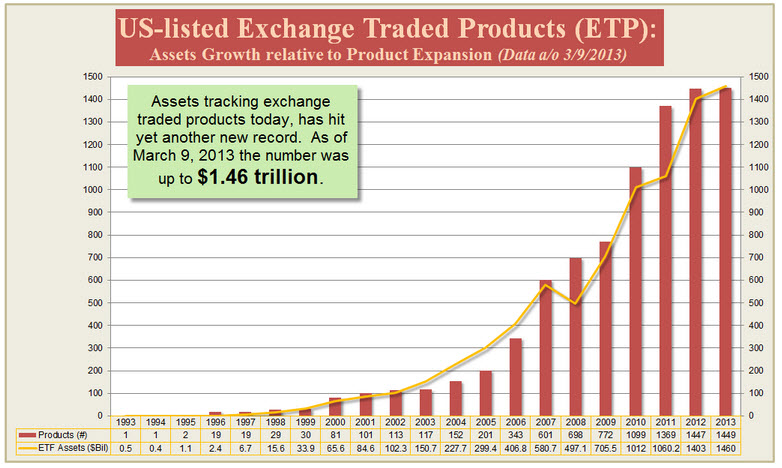
S&P Dow Jones Indices puts together something called the SPIVA Scorecard. This scorecard captures the performance of actively managed mutual funds versus their benchmark indexes (the same benchmark indexes that many ETFs track). The underperformance is staggering. Through the end of 2012, over the past five years, nearly 69% of domestic equity funds underperformed their benchmark. Close to 74% of international mutual funds did the same. Bond mutual funds were even worse as nearly 94% of government long funds and 95% of high yield funds underperformed their benchmarks. It’s no wonder that investors are flocking to mostly passively managed ETFs and driving an industry growth chart that looks like this (source: http://alletf.com/content/exchange-traded-assets-update-march-2013):
Making matters worse for mutual fund investors is that they typically have to pay much higher fees for this underperformance (though, it should be noted that these high fees are more often than not the culprit of this underperformance). The average actively managed domestic equity mutual fund will cost investors around 1.4%. Compare that to an ETF such as the Vanguard Total Stock Market ETF (ticker VTI), which we highlighted on the show. VTI costs a mere 0.06% and offers investors exposure to the same domestic equity market that these actively managed mutual funds are having such a difficult time beating.
In our weekly market update segment, we offered a crash course on the Cyprus banking crisis and explained why the financial markets care about what happens in this tiny island country. Financial media outlets have been in full overdrive reporting on the events in Cyprus, which has spooked some investors. We cut through the noise and explained exactly what’s going on and the potential impact it could have on your investments.