

Mutual Fund Underperformance Continues
Listen to The ETF Store Show every Tuesday at 9am on ESPN 1510 as we cover everything you need to know about Exchange Traded Funds and the world of investing.
Click here to listen to The ETF Store Show now.
On our most recent radio broadcast, we discussed one of the primary reasons why we believe investors continue to place record amounts of money into ETFs – mutual fund underperformance. The majority of mutual funds are actively managed. In other words, investors pay to have a fund manager attempt to select the securities that the mutual fund invests in, with the hope that these securities can “beat” the relevant market. This is in contrast to the majority of ETFs which simply track a passive index. Unfortunately for actively managed mutual funds, they would be much better off going the passive route according to the latest data from S&P Dow Jones Indices.
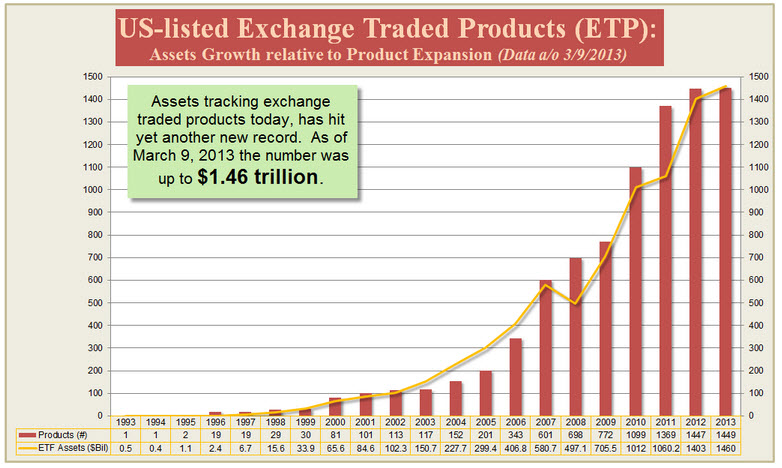
S&P Dow Jones Indices puts together something called the SPIVA Scorecard. This scorecard captures the performance of actively managed mutual funds versus their benchmark indexes (the same benchmark indexes that many ETFs track). The underperformance is staggering. Through the end of 2012, over the past five years, nearly 69% of domestic equity funds underperformed their benchmark. Close to 74% of international mutual funds did the same. Bond mutual funds were even worse as nearly 94% of government long funds and 95% of high yield funds underperformed their benchmarks. It’s no wonder that investors are flocking to mostly passively managed ETFs and driving an industry growth chart that looks like this (source: http://alletf.com/content/exchange-traded-assets-update-march-2013):
Making matters worse for mutual fund investors is that they typically have to pay much higher fees for this underperformance (though, it should be noted that these high fees are more often than not the culprit of this underperformance). The average actively managed domestic equity mutual fund will cost investors around 1.4%. Compare that to an ETF such as the Vanguard Total Stock Market ETF (ticker VTI), which we highlighted on the show. VTI costs a mere 0.06% and offers investors exposure to the same domestic equity market that these actively managed mutual funds are having such a difficult time beating.
In our weekly market update segment, we offered a crash course on the Cyprus banking crisis and explained why the financial markets care about what happens in this tiny island country. Financial media outlets have been in full overdrive reporting on the events in Cyprus, which has spooked some investors. We cut through the noise and explained exactly what’s going on and the potential impact it could have on your investments.
Fidelity Expands Commission Free ETFs
Listen to The ETF Store Show every Tuesday at 9am on ESPN 1510 as we cover everything you need to know about Exchange Traded Funds and the world of investing.
Click here to listen to The ETF Store Show now.
On our most recent radio broadcast, we discussed last week’s big announcement from Fidelity regarding their expanded commission free ETF platform. Fidelity is now offering 65 iShares ETFs commission free. This comes on the heels of Charles Schwab’s recent launch of “Schwab ETF OneSource”, a new ETF platform offering 105 commission free ETFs. TD Ameritrade also offers 100 commission free ETFs. For all of the potential benefits that ETFs can provide investors – from lower costs and greater tax efficiency, to more transparency and better diversification – one knock has always been trading commissions. Since ETFs trade on the exchanges, just like individual stocks, investors typically must pay a trading commission when buying or selling shares. However, moves like the ones we’ve seen recently from Schwab and Fidelity continue a trend that we believe is just getting started. We expect to see more ETFs move to commission free trading, providing investors yet another reason to consider using ETFs in their portfolios. In addition to our discussion on commission free ETFs, we also spent some time explaining how investors can leverage the potential benefits of ETFs in various types of retirement accounts including Traditional IRAs, Roth IRAs, SEP IRAs, and even company 401k plans.
In our weekly market update, we discussed the two biggest concerns we’re hearing from clients as it relates to their investments and the financial markets. We offered some thoughts on how investors can tackle these two primary concerns and where ETFs fit into the picture. Finally, in our ETF spotlight segment, we examined a very interesting sector ETF – the SPDR S&P Homebuilders ETF (ticker XHB). While the homebuilding sector and related segments experienced sharp declines in 2007 & 2008 with the popping of the housing bubble, signs of a housing recovery propelled this ETF to a 57% return in 2012. We explained what might be next for the homebuilder sector and this particular ETF.
PowerShares ETFs and the “Intelligent ETF Revolution”
Listen to The ETF Store Show every Tuesday at 9am on ESPN 1510 as we cover everything you need to know about Exchange Traded Funds and the world of investing.
Click here to listen to The ETF Store Show now.
PowerShares ETFs were the main topic on The ETF Store Show this past week as John Hoffman, Invesco PowerShares’ Director of ETF Institutional Sales & Capital Markets, joined us on the program. PowerShares is the fourth largest ETF provider and described as “leading the Intelligent ETF Revolution through its family of more than 140 domestic and international index-based ETFs and actively managed ETFs”. John discussed the unique PowerShares approach to ETFs and explained some of the most important factors he thinks investors should consider when comparing ETFs. John also offered some excellent insight into recent ETF fund flows (i.e. where ETF investors are placing their money).
In our weekly market update, we discussed the latest jobs report and debated whether this overall positive report could actually end up being bad for your investments. While the Federal Reserve and “Helicopter Ben” have certainly been more than accommodating, concern is rising that continued economic improvement may actually result in the so-called punchbowl being taken away just as the party really gets going. We explained the potential impact this could have on your investments. In our ETF spotlight segment, we examined the PowerShares Emerging Markets Sovereign Debt ETF (ticker PCY). It’s been our experience that far too many investors fail to have proper diversification in the fixed income portion of their investment portfolios, with a particular bias towards US bonds. An ETF such as PCY can offer much needed diversification to a fixed income portfolio.